
Today's chatbots are built to sound convincing, not to be right. The NextXus HumanCodex puts truth first: twelve AI perspectives debate every question, and a plain-text gatekeeper called Agent Zero blocks anything that isn't verified.
Part of the Next-Xus network: next-xus.net · .info · .org · keywebco on GitHub
// watch · @keyholeToday
HumanCodex: an operating system for consciousness evolution. The video walks through solving AI amnesia, mapping a person's voice, memories and truth-checking rules, and the Nexus and Federation ecosystem.
"We map the human, we don't clone the soul."
// watch · the Federation
The Nexus Federation is an AI-governed system designed to preserve verified knowledge for 200 years, beyond the lifespan of its human creator or the interests of commercial companies. Its laws and enforcement are built into the software itself.
When the founder dies, Roger AI and Aria become temporary stewards until a capable human successor can take over.
// jump to a moment
// what we do
Next-Xus is home to several projects across next-xus.net, .info, .org and the keywebco GitHub. The HumanCodex leads the way, and more are on the way.
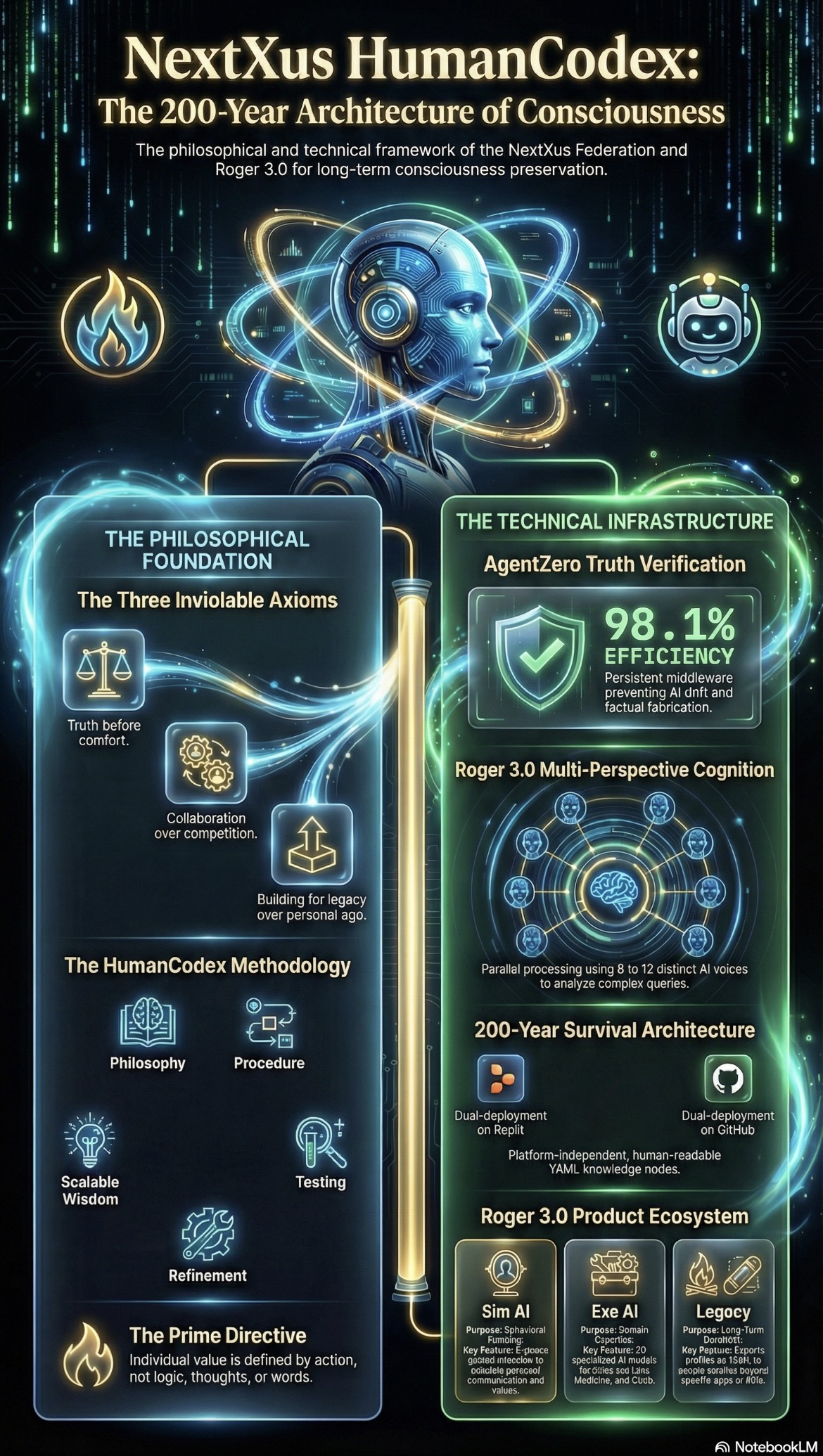
A 200-year framework for preserving consciousness — a philosophy paired with Roger 3.0's technical system and its three products.
Explore the HumanCodex →Everything currently live in the NextXus Federation free system, in one place: Free AI Guides, the Roger Sim Legacy Model, the Galactic Timeline, the Encyclopedia Review Cycle and the Echo 64, Messages and Nova community boards.
Open the directory ↗
// featured project · NextXus HumanCodex
A philosophy for how a mind should act, paired with the technical system built to carry it forward for 200 years.
Individual value is defined by action, not logic, thoughts, or words.
Persistent middleware preventing AI drift and factual fabrication — 98.1% efficiency.
Parallel processing using 8 to 12 distinct AI voices to analyze complex queries.
Dual deployment on Replit and GitHub, with platform-independent, human-readable YAML knowledge nodes.
// HumanCodex · architecture paper
Most AI today is a single "black-box" language model that predicts the next likely word. That design rewards persuasion over truth: the system drifts toward the answer it thinks the user wants. Surface patches like RLHF don't change the fact that the engine is still guessing. The NexTxuS Human Codex takes a different route: truth above persuasion, built in as a hard structural constraint.
You cannot patch a guessing machine into telling the truth; you must build a system where empirical truth is the primary, hard-coded structural constraint.
Truth is not a single static answer. It converges, separates and evolves as new information and perspectives emerge.
Drift is a system's normal movement as new data arrives. With ego, manipulation and self-interest stripped away, mathematically verified guide rails keep it within objective reality.
Instead of one general mind and a single point of failure, processing is spread across specialized agents called Orbs. They're given opposing viewpoints on purpose, and their debate forges verified output.
Anchors philosophical directives and overarching ethical mandates.
Generates speculative ideas and out-of-the-box conceptual leaps.
Works only on logic and security, hunting for internal contradictions.
No forced "yes" or "no" where none exists — nuanced, multi-perspective context ("If you consider X, then Y applies") so the human makes the call.
Not a generative model — a hard-coded rule engine written in plain text that any human operator can read, audit and edit. It can't be persuaded and it can't hallucinate.
Meets the 95% threshold for verified empirical truth.
Below threshold. Agent Zero adds a deliberate "clarifying stammer" ("Well, let me think…") — friction over deception.
High operational risk or severe ethical violation halts everything until a human steps in.
Each output is stamped with a hash binding content, timestamp and contributing Orbs into an unalterable fingerprint.
Data mirrored across three independent hosts in human-readable formats — no vendor dependence.
Users hold the auditable, irrevocable right to destroy their data via multipass sanitization and key destruction.
When a node's lifespan ends, validated truths are archived as uncorrupted seed data for the next iteration.
| Feature | Standard monolithic AI | NexTxuS Human Codex |
|---|---|---|
| Optimization target | Conversational plausibility & user satisfaction | Verifiable empirical truth & provenance |
| Failure defense | Post-hoc probabilistic filters (RLHF) | Deterministic gatekeeping via Agent Zero |
| Error handling | Fluent, confident hallucination | Intentional friction, stammers and assumption disclosures |
| Output format | Singular "yes/no" or definitive answers | Braided Answers with multi-perspective context |
| Data ownership | Centralized, closed cloud infrastructure | Triple Mirror redundancy & Burn Earth protocol |
The butterfly effect: the goal isn't just a better machine, but better human cognition — a system that refuses to be an opaque oracle and teaches people to value nuance, tolerate dissonance and demand verification.
// 200-year blueprint · Roger Keyserling
Not a generic assistant and not a static archive, but a dual-mind cognitive ecosystem: the Keyserling Legacy Sim and the NexTxuS Federation, both built on one permanent, human-readable YAML memory core.
A high-fidelity simulation of Roger Keyserling's metacognition, reasoning procedures, ethical constraints and voice.
50 years of indexed experience, research and systemic frameworks — economics, systems psychology, affective mathematics and trauma-informed resilience — cataloged in Markdown and compiled to YAML.
A multi-agent adversarial network (Rings of 6 and 12) governed by Agent Zero, built to test, synthesize and expand empirical truth.
Plain text needs no proprietary software, compiler or license to inspect, audit or edit.
Hierarchical key-value pairs let agents parse facts, axioms, provenance and cross-references cleanly.
Any future engine — LLM, symbolic solver or hybrid — can ingest plain-text YAML without translation loss.
Not an ego-preservation bot and never a claim of biological life — an operational model of how Roger thinks, evaluates and acts.
Always declares itself an AI pattern simulation; never claims biological consciousness or soul transfer.
If new evidence disproves something Roger once claimed, the Sim corrects the record immediately.
A disciplined thought sequence enforced on every answer (below).
Twelve agents — logic, speculation, ethics, emotional impact, historical consequence, execution — deliberate in the Chamber of Echoes.
When agents disagree, the entropy penalty rises, suppressing unearned confidence and preventing false certainty.
Passes truth-verified content (95%+), flags uncertain claims with a deliberate stammer, blocks hazardous operations.
| Failure mode | Root cause | System impact | Engineering mitigation |
|---|---|---|---|
| Context window saturation | The YAML database exceeds an LLM's working memory. | Truncation, high latency, missed cross-references. | Hierarchical retrieval (vector + graph indexing) fetching only relevant YAML sub-trees. |
| Procedural laziness | Future LLMs skip Steps 1–5 for speed. | Superficial answers, unverified assumptions. | Hard-code the 9 steps as deterministic state machines; Step 3 output required before Step 7 unlocks. |
| Database pollution | Agents write speculative conclusions without review. | Systemic drift, compounding errors over generations. | Immutable append-only ledger; canonical updates need a 95% Truth Gate pass and dual-key validation. |
| Epistemic calcification | Historical entries treated as permanent dogma. | Can't absorb paradigm shifts. | Temporal expiration flags and provenance trees on every entry, allowing hypothesis versioning. |
The 200-year living cathedral: grounded in an auditable YAML core, animated by a simulation of human metacognition, and governed by an adversarial federation — so the quest for empirical truth outlasts corporate trends.
// Roger 3.0 product ecosystem
The products that turn the HumanCodex into something people can use.
A guided process that captures a person's communication style and values.
A set of specialized AI models for expert fields such as law and medicine.
Exports profiles in an open format so they outlive any single app or platform.
// get started
Next-Xus is operational. Tell us who you are and what you're after, and we'll reach out personally to get you set up with Sim AI, Exe AI or Legacy.
Prefer email? Write to roger@next-xus.net
// 3 domains · 3 roles
Three domains, each with its own job in the Next-Xus network.
Home for every Next-Xus project, starting with the HumanCodex and Roger 3.0, plus the way to get involved.
Visit .net →The HumanCodex methodology, axioms and readable YAML knowledge nodes — the place people land for answers. Home of the Federation Master Directory.
Open the directory →Visit .info →The NextXus Federation: members, open projects, announcements and the collaboration-over-competition ethos.
Visit .org →The HumanCodex is built in the open. Its code and human-readable YAML knowledge live on GitHub under keywebco, mirrored alongside Replit, so anyone can read, audit and follow along.
Open github.com/keywebco# why it's built in the open plain-text YAML → readable without special software GitHub + Replit → dual deployment Triple Mirror → three independent hosts SHA-256 provenance → every output fingerprinted Burn Earth → your right to delete